Most people dealing with hair fall make the same mistake — they react to it instead of addressing it. They switch shampoos, try oil after oil, and add more steps to their routine, hoping something will finally work. But a routine built on guesswork rarely solves the problem. What actually helps is understanding what your hair needs and building around that.
Why Most Hair Care Routines Fail
The most common reason hair care routines don’t work is that they’re built around products, not principles. People stack up serums and masks without knowing what their scalp actually needs. Hair fall isn’t always a product problem — it’s often a signal that something deeper is off.
There are a few things that routinely get overlooked:
- Overwashing or underwashing the scalp, both of which disrupt the natural oil balance
- Using heat tools without any thermal protection
- Tying hair too tightly too often, which puts physical stress on the follicle
- Skipping scalp care entirely while focusing only on the hair shaft
The shaft is dead protein. The scalp is where the real work happens. Any routine that ignores the scalp is missing the point.
Understanding the Root Cause of Hair Fall
Hair fall has many possible causes — nutritional deficiencies, hormonal changes, chronic stress, scalp conditions like dandruff or seborrheic dermatitis, or even something as simple as sleeping on rough cotton. Without identifying the actual trigger, no routine will be fully effective.
For example, if you’re deficient in iron or vitamin D, your hair follicles won’t get the support they need to complete a healthy growth cycle. No topical product can fix that. Similarly, if your scalp has chronic inflammation or excess DHT sensitivity, your follicles will gradually shrink over time regardless of how many oils you apply.
This is why understanding what’s driving the fall matters before building any routine. A good hair care regim starts with observation — how much hair are you actually losing, from where on the scalp, and does it come in cycles or consistently?
Building a Routine That Works
Once you have some clarity on the cause, building a routine becomes more focused. Here’s how to think about each part of it:
- Scalp cleansing: Wash your hair often enough to keep the scalp clean but not so frequently that you strip it dry. For most people, two to three times a week works well. Use a mild, sulfate-free shampoo.
- Conditioning: Focus conditioner on the mid-lengths and ends, not the scalp. Buildup near the roots can clog follicles.
- Oiling: If you oil, do it a few hours before washing — not overnight. Long oil sit-times can attract dust and potentially worsen scalp conditions in some people.
- Drying: Air-dry when possible. If you use a blow dryer, keep it on a low or medium heat setting and hold it at least six inches from the scalp.
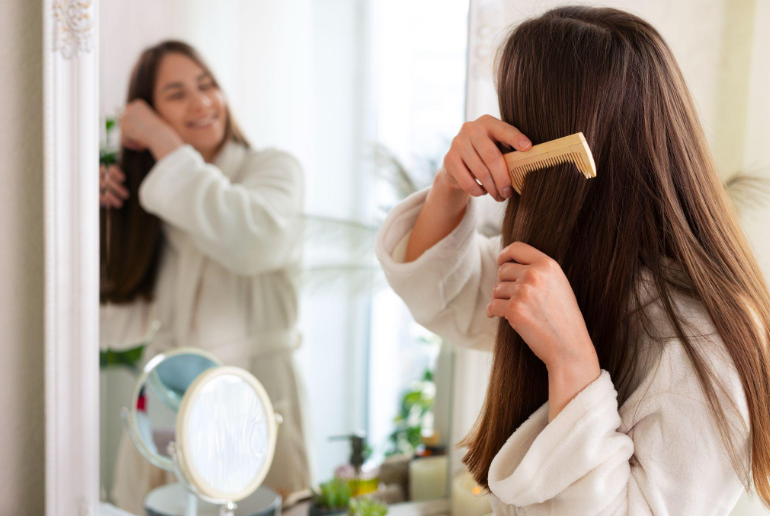
- Combing: Use a wide-tooth comb on wet hair. Brushing wet hair roughly is one of the most common causes of breakage.
Nutrition Is Part of the Routine Too
Hair health doesn’t begin at the scalp — it begins in the gut and the bloodstream. Protein, iron, zinc, biotin, and omega-3 fatty acids are all critical for healthy follicle function. A diet consistently low in these nutrients will eventually show up as thinning hair or increased shedding.
Adding a few eggs, leafy greens, nuts, and legumes to your daily meals can make a real difference over time. It’s not dramatic or fast, but it’s sustainable.
When to Look Beyond DIY
If your hair fall has been consistent for more than three months, or if you’re noticing patterned thinning rather than general shedding, it’s worth getting a proper assessment. A complete hair regrowth routine should address scalp health, internal nutrition, stress management, and long-term consistency rather than relying on a single product alone. In this context, Traya hair products are designed around a combined approach that includes Ayurvedic care, nutritional support, and scalp-focused solutions to target multiple causes of hair fall together.
Final Thoughts
Building a hair care routine that reduces fall isn’t about doing more — it’s about doing the right things consistently. Clean the scalp properly, support your body with good nutrition, handle your hair gently, and take time to understand what’s actually causing the fall. That kind of intentional approach will always outperform the product-switching cycle that most people get stuck in.