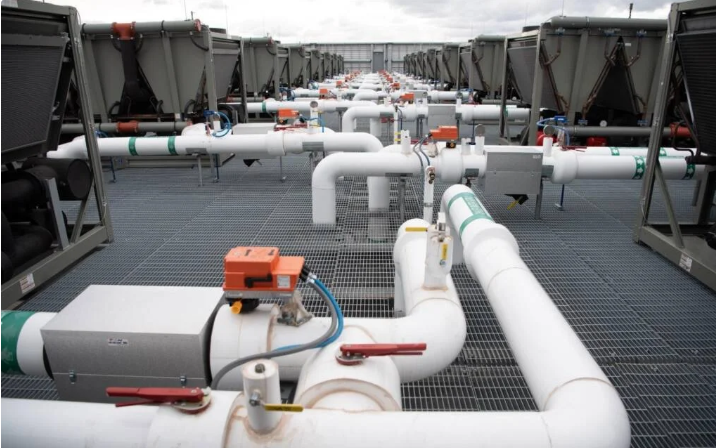
Data center construction schedules leave little room for field rework. Mechanical equipment must arrive when expected, fit within the allotted space, connect to supporting infrastructure, and operate as part of a coordinated cooling system.
These requirements have increased interest in modular equipment that can be assembled and tested before reaching the project site. For liquid-cooling infrastructure, skid-based construction can shift a substantial portion of mechanical, electrical, instrumentation, and controls work into a controlled fabrication environment.
The benefits, however, depend on how thoroughly the system is planned before fabrication begins.
Moving Work Away From the Jobsite
Traditional field construction requires multiple trades to complete work in sequence. Piping may need to be installed before instruments can be added, while electrical and controls work may depend on the final location of mechanical components.
Congested job sites make that coordination more difficult. Crews may be working in limited space alongside other contractors while equipment deliveries and construction activities compete for access.
Offsite fabrication allows more of the work to occur before the equipment arrives. Depending on the project scope, a modular package may incorporate:
- Pumps and drives
- Heat-transfer equipment
- Valves and piping
- Filtration
- Instrumentation
- Electrical panels
- Controls
- Structural supports
- Connections for facility and technology loops
This approach does not eliminate fieldwork, but it can reduce the number of individual connections and assembly steps completed onsite.
Earlier Decisions Become More Important
Modular construction shifts work earlier in the project timeline. This can support a faster installation, but only when design requirements are defined before fabrication begins.
The project team needs to establish:
- Required cooling capacity
- Operating temperatures and flow
- Pressure conditions
- Fluid requirements
- Redundancy strategy
- Control sequences
- Communication protocols
- Utility connections
- Equipment orientation
- Access and maintenance clearances
Late changes may have a greater impact after fabrication is underway. A revised connection location, instrument requirement, or control philosophy can affect piping, wiring, programming, structural supports, and testing.
A disciplined design-review process is therefore central to the success of modular deployment.
Coordination Must Extend Beyond the Skid
A skid may be fabricated as an integrated package, but it still operates as part of a larger system. Its performance depends on conditions supplied by the facility and the requirements of the technology loop.
Interfaces that require coordination include:
- Facility-water temperature and availability
- Supply and return piping
- Electrical service
- Network communication
- Drain, vent, and fill provisions
- Floor loading
- Door, corridor, and rigging clearances
- Connection sizes and locations
- Available space for maintenance
A skid can meet its own design specification and still create project problems if these interfaces are not aligned.
For example, the equipment may physically fit in its final position but be too large to move through an existing doorway. Connections may match the drawings but interfere with overhead services installed by another contractor. Maintenance clearances may also disappear if nearby equipment changes after the skid layout is approved.
Factory Testing Can Reveal Problems Earlier
One advantage of modular fabrication is the opportunity to inspect and test an assembled system before shipment.
The testing scope should be defined during procurement rather than assumed. Depending on the project, evaluation may include:
- Weld and joint inspection
- Pressure or leak testing
- Instrument calibration checks
- Electrical-panel inspection
- Verification of input and output signals
- Control-sequence testing
- Alarm simulation
- Pump rotation and functional checks
- Communication testing
- Review of labeling and documentation
Factory acceptance testing can reveal problems while the equipment remains in an environment equipped for correction. Resolving an issue before shipment is generally less disruptive than discovering it during startup at a busy project site.
Project teams should also identify which stakeholders need to participate in or witness testing. Mechanical engineers, controls specialists, facility representatives, and commissioning providers may evaluate different aspects of the package.
Design for Transportation and Installation
Equipment that performs well in a fabrication facility must also withstand transportation, unloading, rigging, and placement.
The design should account for:
- Overall shipping dimensions
- Equipment weight
- Lifting points
- Temporary bracing
- Protection for instruments and connections
- Shipment in one or several sections
- Reassembly requirements
- Final positioning and anchoring
When reviewing cdu skids, project teams should consider not only cooling performance but also how the equipment will be transported, connected, tested, and serviced at the destination.
If a large package must be divided for shipment, the break points should be planned carefully. Reassembly work should be clearly documented so that the advantages of offsite fabrication are not lost through extensive field reconstruction.
Preserve Maintenance Access
Compact design is often treated as a primary advantage of skid-mounted equipment. However, minimizing the footprint without considering service access can create long-term problems.
Personnel may need to reach:
- Filters and strainers
- Pump seals or motors
- Valve actuators
- Sensors
- Electrical components
- Heat-transfer equipment
- Drain and vent points
Frequently serviced components should not require the removal of unrelated equipment. Doors and panels must be able to open after installation, and components that may eventually need replacement should have a practical removal path.
Three-dimensional layout reviews can help identify these concerns, particularly when the model includes adjacent walls, columns, piping, and equipment.
Plan for Commissioning Before Shipment
Factory testing does not replace site commissioning. Conditions at the project location will differ from those used during fabrication, and the skid must be tested as part of the complete cooling system.
Site activities may include:
- Inspecting the equipment after shipment
- Confirming utility connections
- Flushing and filling the connected loops
- Removing trapped air
- Checking rotation and valve position
- Verifying sensors
- Confirming network communication
- Testing operating sequences
- Simulating alarms or failures
- Documenting final setpoints
Responsibility for each task should be established before the equipment arrives. Clear commissioning boundaries help prevent important steps from being assumed by one party and omitted by another.
Treat Modular Equipment as a Project Strategy
Skid-based cooling equipment can reduce field labor, consolidate responsibility, and enable earlier system testing. It can also support repeatable deployment when a facility plans to add cooling capacity in phases.
Those advantages come from integration, not simply from mounting components on a frame. Successful modular projects require early decisions, well-defined interfaces, coordinated layout reviews, appropriate factory testing, and a realistic plan for site installation and commissioning.
When those elements are addressed, modular construction can reduce uncertainty at the jobsite and provide a more controlled path from design to operation.