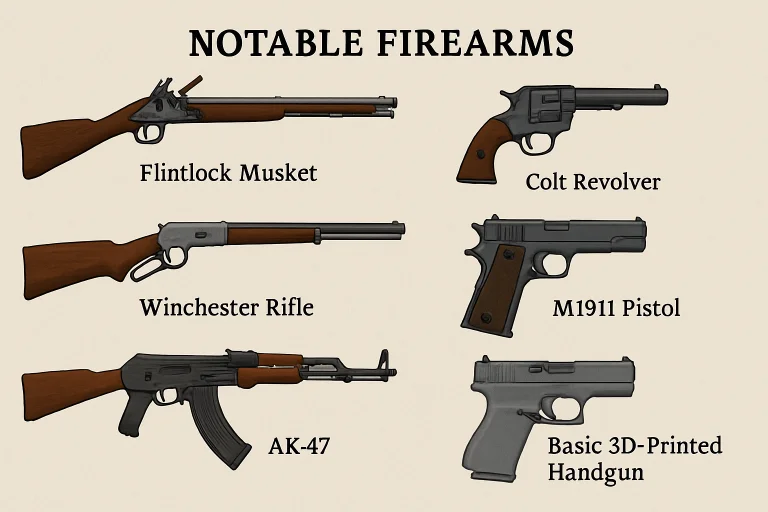
Throughout history, innovations in firearm technology have not only revolutionized warfare but have also profoundly influenced broader society. From primitive ignition systems to advanced 3D printing, landmark developments in firearm design have left an indelible legacy on how modern weapons are engineered, manufactured, and used. In particular, several iconic models and mechanisms have driven progress and inspired technological advancements seen in firearms today. For those interested in sourcing ammunition compatible with historic and modern firearms, particularly in Canada, Winchester Ammunition Canada provides a reliable option for enthusiasts and collectors alike.
This exploration of pivotal firearm milestones reveals how each innovation reflected the needs, challenges, and ingenuity of its era, shaping both the weapons themselves and the world around them. As technology evolved, so too did the function, efficiency, and cultural significance of firearms, with many classic designs enduring as a foundation for both hobbyists and major institutions.
The Flintlock Mechanism
The early 17th century marked a pivotal moment in firearm history with the advent of the flintlock mechanism. Prior ignition systems were often slow and unreliable, but the flintlock produced sparks by striking flint against steel, enabling a more consistent, rapid rate of fire. According to HowStuffWorks, this innovation significantly improved infantry efficiency on the battlefield and enabled more flexible tactics, altering the dynamics of warfare.
Flintlocks dominated firearm technology for over two centuries, influencing both military and civilian life. Their widespread use affected European conflicts and the colonization of the Americas, shaping the course of history. While eventually replaced by percussion cap systems, the flintlock’s design and engineering principles remain a cornerstone of firearm development.
The Colt Revolver
In 1836, Samuel Colt’s patented revolver design marked the emergence of accurate repeating handguns. Prior to this, pistols typically discharged a single shot before requiring laborious reloading. Colt’s breakthrough was the revolving cylinder, capable of holding multiple charges, allowing users to fire several rounds in succession before reloading. This development dramatically enhanced both personal defense and law enforcement capabilities.
The widespread adoption of the Colt revolver in the United States catalyzed further innovation.
The Winchester Model 1873
The phrase “the gun that won the West” is almost invariably linked to the Winchester Model 1873. Recognized for its lever-action operation and the ability to fire multiple rounds rapidly, the Model 1873 quickly became the weapon of choice for pioneers, ranchers, and lawmen across North America. Its ease of use and reliability made it an indispensable tool during the settlement of the American frontier.
The mechanical principles behind the Model 1873 set standards not just for hunting and defense, but for the entire category of repeating rifles. Its success influenced the evolution of both lever-action and later semi-automatic rifles, ensuring that the legacy of Winchester’s innovation endures in contemporary firearm engineering.
The M1911 Pistol
When John Browning designed the M1911 pistol for the U.S. Army, he introduced a weapon that would become legendary for its reliability and firepower. With a design that made use of the powerful .45 ACP cartridge and a straightforward, robust operating mechanism, the M1911 served as the standard-issue sidearm for American forces from World War I through Vietnam and remains widely respected today.
The M1911 was not only significant for its combat performance but also for the design philosophy it introduced: ruggedness, ease of maintenance, and adaptability. The principles behind the M1911 have influenced countless semi-automatic pistols since, and it remains a popular choice among military, law enforcement, and civilian shooters.
The AK-47
Emerging from post-World War II Soviet engineering, the AK-47 set the standard for modern military rifles due to its remarkable durability, affordability, and simplicity of use. Mikhail Kalashnikov’s design was quickly adopted by Soviet and allied forces worldwide, and its distinctive appearance has since become one of the most recognized in the world. The unparalleled reliability and ease of maintenance of the AK-47 have led to its adoption by dozens of countries and countless military forces. Its legacy can be seen in the design of many contemporary assault rifles, and it often features in discussions about the proliferation of small arms and their influence on global conflict.
The Glock 17
The introduction of the Glock 17 in the 1980s marked a new era of modern handgun design, driven by the widespread use of durable polymer materials. Lightweight, simple to operate, and featuring a high-capacity magazine, the Glock 17 rapidly gained popularity among law enforcement agencies and civilians alike. Its innovative approach to manufacturing, paired with an emphasis on reliability and safety features, helped reset industry expectations for what a duty or personal defense pistol could offer. Glock’s concept of blending modern materials with enduring mechanical reliability continues to shape handgun design worldwide.
3D-Printed Firearms
The twenty-first century has witnessed a dramatic shift with the development of 3D-printed firearms. These weapons, constructed from digital blueprints using lightweight materials, first entered public consciousness in 2013 and have since sparked significant debate over safety, legality, and the future of gun control. While the technology is still evolving, the capacity to design and manufacture functional firearms outside traditional industrial channels could represent a paradigm shift in both the availability and control of weapons. The debates surrounding 3D-printed firearms reflect concerns over regulation, intellectual property, and the democratization of weaponry.
Conclusion
The evolution of firearm designs illustrates not only technological progress but also changes in society, warfare, and security. From the dependable flintlock to the revolutionary AK-47 and polymer-framed Glocks, each innovation has left a legacy that continues to inform modern armament development. Understanding these landmark designs helps us appreciate the sophistication of current firearms and underscores the importance of responsible innovation for the future.